
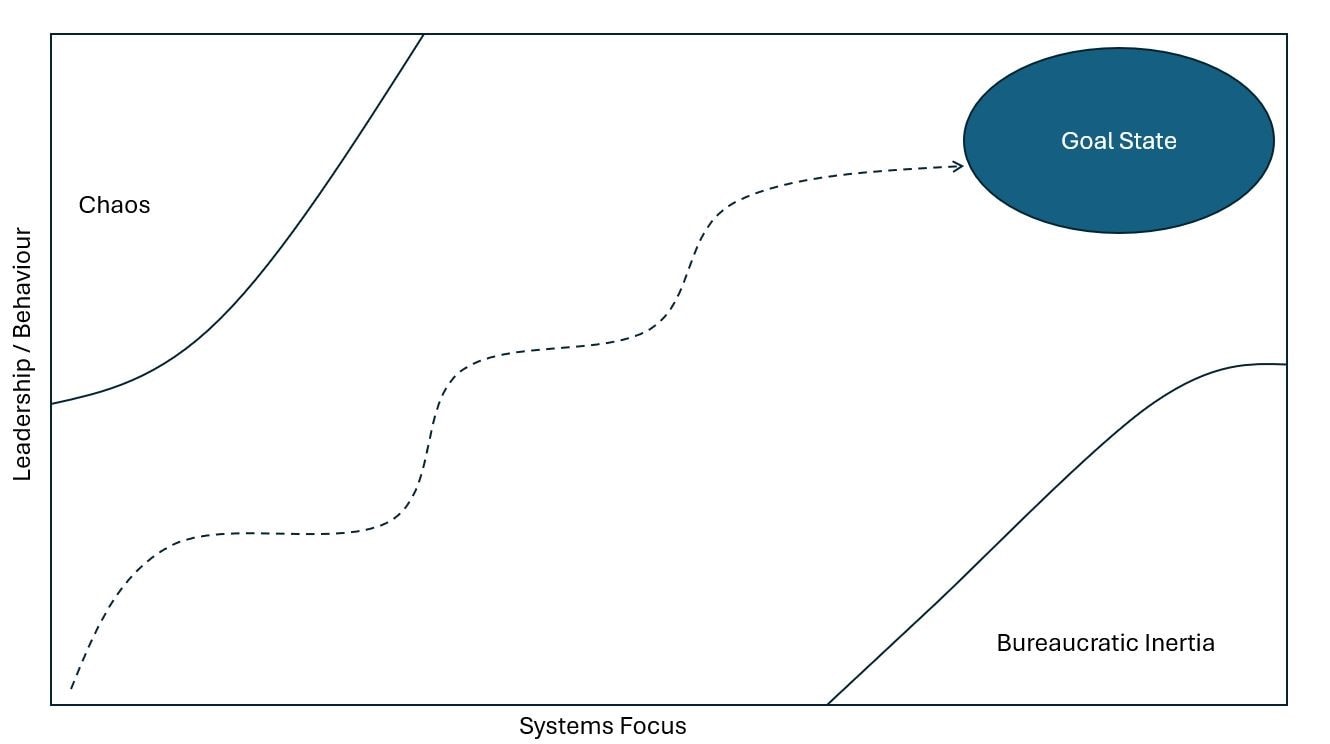
The relentless pursuit of a goal often leads businesses to a familiar crossroads. On one path lies the allure of rigidity and control – a world of meticulously crafted systems and processes. The other path beckons with the promise of agility and innovation, fuelled by charismatic leadership and empowered behaviour. But what if the most successful organisations don’t choose a path at all? What if the answer lies not in a singular focus, but in a delicate balance between systems and leadership?
The Pitfalls of Process Paralysis
Organisations that overemphasise systems and processes often fall victim to bureaucracy. It’s our view that this is one of the key drivers that has led us to the current push to remove safety clutter. Bound by endless rules and approvals, decision-making becomes sluggish, innovation suffocates, and effectiveness plummets. Employees, yearning for autonomy, become disengaged, simply going through the motions to navigate the labyrinthine procedures. Metrics, generally lagging or activity based, become the sole measure of success, stifling creativity, and encouraging a “check-the-box” mentality. It’s the worst of the world of traditional safety.
The Leadership Labyrinth
Organisations that overemphasise leadership and behaviour, on the other hand, can quickly descend into chaos. While strong leadership inspires and engages, a singular focus on charisma can create a company overly reliant on a single visionary figurehead. Subordinate leaders can consistently seek to emulate this ‘loose’ approach. Without robust systems and processes to guide decision-making and execution, even the most brilliant leaders can struggle to maintain consistency and outcomes, including safety, suffer. The organisation becomes susceptible to impulsive decisions, perceived poor procedural fairness and inconsistent performance, ultimately hindering long-term performance. Also leading to cultural mythologies that undermine the intent of leadership.
The Balancing Act
The key to unlocking true organisational effectiveness lies in achieving equilibrium. Successful organisations recognise that systems and leadership are not opposing forces, but rather complementary elements of a cohesive whole. Robust and resilient processes provide a foundation for consistency and efficiency, while empowered leadership fosters a culture of innovation and agility.
Identifying Your Tilt
So, how can you tell if your organisation is leaning too far in one direction or the other? Here are some weak signals and questions to explore:
PROCESS PARALYSIS
- Is decision-making agonisingly slow?
- Do employees feel stifled by excessive rules and procedures?
- Is there a constant sense of frustration with internal bureaucracy?
LEADERSHIP LABRYNTH
- Is the organisation overly reliant on a single leader’s vision?
- Are there inconsistencies in performance across different teams or departments?
- Is there a fear of taking risks or proposing new ideas?
Building a Balanced Organisation
Once you’ve identified your tilt, here are some steps to achieve balance:
FOR THE PROCESS-HEAVY
- Streamline procedures and empower employees to make decisions within defined parameters.
- Encourage experimentation and innovation within a structured framework of tolerances.
- Focus on metrics that capture both efficiency and effectiveness of outcomes.
FOR THE LEADERSHIP-DRIVEN
- Develop robust systems and processes to support growth, adaptability and consistency.
- Encourage collaboration and knowledge sharing across teams.
- Measure leadership effectiveness not just by charisma, but also by the ability to cultivate a high-performing and engaged workforce.
The Bottom Line
Balance is an ongoing pursuit, not a one-time achievement. By actively assessing your organisation’s lean and taking steps to achieve equilibrium, you unlock the true potential of both systems and leadership, creating an environment where innovative ideas flourish within a framework of efficiency, ultimately propelling your organisation towards sustainable success.